

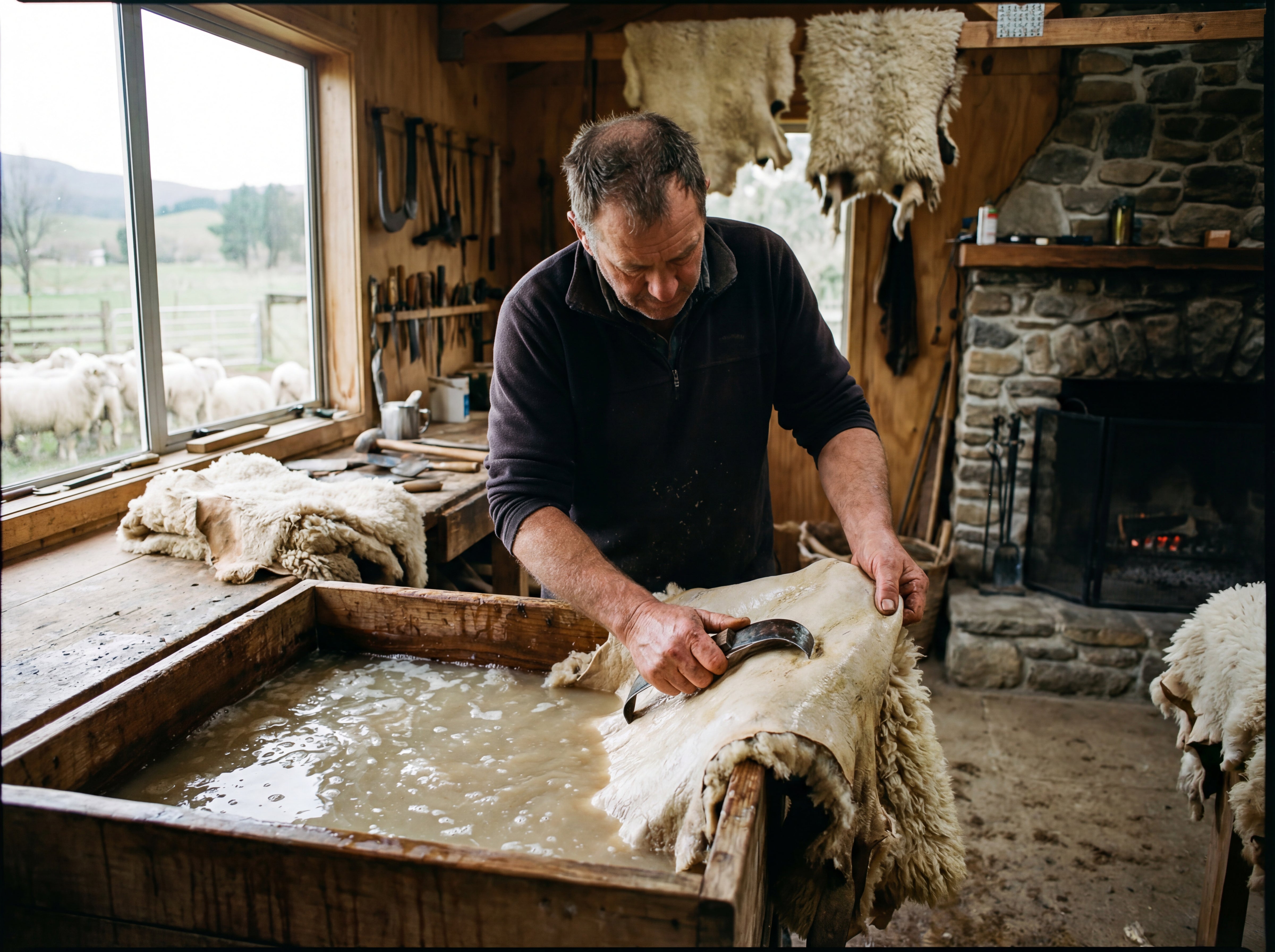
How is sheepskin tanned? An overview of the tanning process.
Genuine sheepskin is a high-quality natural product. The warm, fluffy wool and soft leather come from nature, more precisely from real sheep. Everyone knows that skin and hair need care. Unlike us humans, sheep don't use moisturizer or conditioner to care for their fluffy wool; nevertheless, the sheep provides their skin and hair with valuable nutrients and thus nourishes them. When sheepskin is harvested, this natural supply of nutrients is lost, and the question arises: How can genuine sheepskins, whether as a popular decorative object or fashion item, remain shiny and supple even after years of use? How can one ensure that genuine sheepskin doesn't lose its quality or even rot over time?
The key word is "tanning".
Fundamentals of tanning
Those who have already dealt extensively with the processing of sheepskins and leather have certainly come across the term "tanning." But what exactly is meant by tanning?
Sheepskins have been prized for many years for their natural sheen and unique softness. To ensure that the popular natural qualities of sheepskins are preserved for as long as possible, the hides obtained from sheep must first be properly processed before they can find their way into our homes and spread their cozy luster. Tanning is an important step in this sheepskin processing. More precisely, tanning refers to the preservation process that uses various vegetable or chemical tanning agents to transform raw sheepskin and freshly obtained sheepskins into a high-quality product.
Step-by-step process of sheepskin tanning
Rawhide preparation
In order for sheepskins to ultimately yield a high-quality product, it is important that they are processed correctly immediately after harvesting and prepared for the further production process. The processing begins with a thorough cleaning. The focus here is primarily on removing dirt and excess grease from the raw hides, so that the hides are not only clean but also optimally prepared for the subsequent processing steps.
pickling
Once the sheepskins have been thoroughly cleaned, they are mordanted. This is an essential step in preparing the sheepskins for tanning. The surface structure of the fur and leather is altered by mordants, allowing the tanning agents to penetrate and work more effectively during the subsequent tanning process. Without the use of mordants, the effectiveness of the tanning process could be significantly impaired, and the quality of the final product could not be guaranteed.
tanning
Following the pickling of the sheepskins, the tanning process begins. As mentioned earlier, this is a preservation process that uses specific pickling agents to make both the leather and the fur more durable and softer, thus increasing the quality of the sheepskin. It is important to know that the choice of tanning agents also plays a crucial role and determines the characteristics of the final product, as each tanning agent offers its own unique advantages.
There are many different tannins, but perhaps the most important distinction is between plant-based and chemical tannins.
Vegetable tanning uses plant extracts such as oak bark or chestnut, while chemical tanning uses chemicals such as chromium salts. Essentially, all tanning agents aim to improve the durability and quality of sheepskins.
Post-treatment
Following tanning, the sheepskins are gently dried and softened. Even though tanned sheepskins are relatively robust, they should not simply be dried in a tumble dryer. To dry the tanned sheepskin as gently as possible, most are air-dried and regularly kneaded and shaken to soften the individual fibers of the fur and leather. Larger producers often use special drying machines as an alternative to air drying.
To ensure customers receive only flawless products, the sheepskins are inspected again for defects after drying. Depending on whether the sheepskin already meets the quality standard, further processing may be carried out to guarantee 100% customer satisfaction.
Advantages and disadvantages of the different tanning methods
We have already briefly mentioned that the different tanning agents offer various advantages, and the type of tanning agent used should be chosen depending on the desired end product.
To help you choose the right sheepskin for yourself, we will compare the main advantages of vegetable and chemical tanning below.
For many people, sheepskin is a very popular product because it combines luxury and sustainability. For those who place particular importance on sustainability and naturalness, vegetable-tanned sheepskin is probably a better fit. Since only purely plant-based extracts are used, the processing of the hides is more environmentally friendly and sustainable. The sustainability aspect is further enhanced by the exceptional durability of vegetable-tanned sheepskins.
However, chemical tanning also offers several advantages. The tanning process is significantly faster than vegetable tanning due to the use of chemical tanning agents. Therefore, if you want your sheepskin as quickly as possible, a chemically tanned sheepskin is the right choice. Chemically tanned sheepskin is also characterized by its exceptional durability.
Uses and care of tanned sheepskin
Not every sheepskin needs to be tanned to be used by humans. However, since the uses for tanned sheepskins are significantly more diverse than for untanned ones, and the quality and durability of tanned hides are considerably higher, almost all sheepskins are tanned nowadays. These tanned hides are popular for clothing, furniture, blankets, and accessories.
Regardless of how the sheepskins are ultimately used, they must be cared for regularly and properly so that they remain soft and fluffy for as long as possible. Although tanning makes sheepskins more robust, they should still be vacuumed, brushed, and shaken out regularly. While doing this, always check your sheepskin for any defects, such as an unpleasant odor or increased stiffness. The more frequently and thoroughly you check the condition of your sheepskin, the faster and more effectively you can address any signs of wear and tear.
Conclusion
In summary, tanning is an extremely useful preservation process for maintaining the beloved fluffiness and softness of sheepskins for as long as possible. Knowledge of sheepskin tanning will not only help you choose the right sheepskin for your needs, but will also give you a better understanding of how to care for and clean sheepskins.
Share:
This is how you can wash real lambskin
Sheepskin leather hard after washing